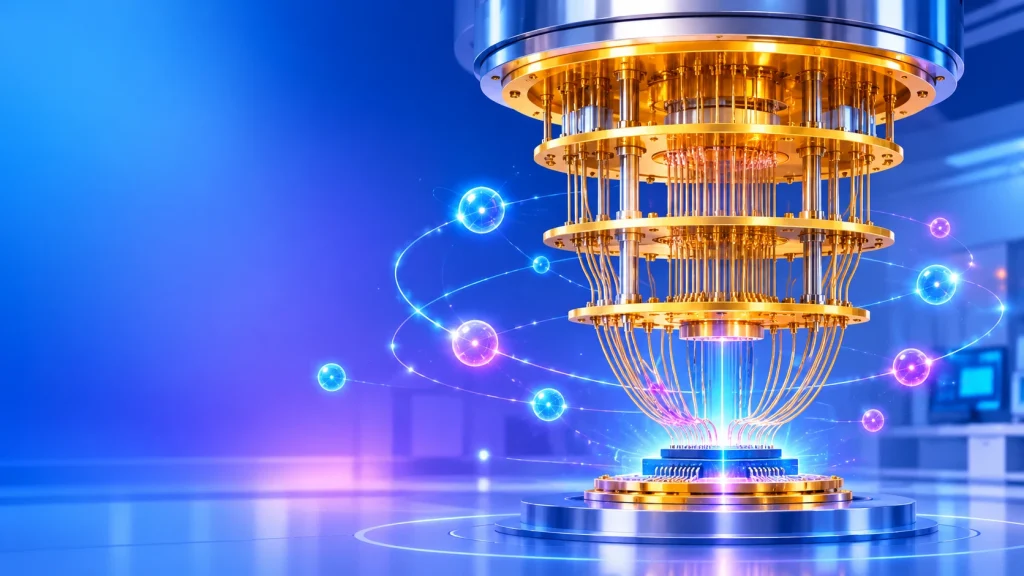
Yes, quantum computers exist. Companies such as Google, IBM, Quantinuum, IonQ, QuEra and D-Wave have built working machines, and some can be used through the cloud. They are not the all-powerful machines of science fiction, though. They are still small, noisy and good at only a narrow set of problems.
A quantum computer is a computer that uses the rules of quantum physics to process information. Instead of ordinary bits, which are always 0 or 1, it uses qubits. A qubit can be in a mix of 0 and 1 until it is measured, and qubits can be linked together through a property called entanglement.
This guide explains what exists today, how quantum computers differ from your laptop, the main types being built, what they can actually do, and what is still hype.
Do quantum computers exist?
Yes. Several companies run real quantum processors today, and researchers keep reporting new records. The table below lists some of the best-known machines and results, as reported by industry trackers.
| Company | Machine | Size | What was reported |
|---|---|---|---|
| Google Quantum AI | Willow | 105 qubits | Below-threshold error correction (Dec 2024) |
| IBM | Condor | 1,121 qubits | Largest single chip, a scale demonstration (Dec 2023) |
| Quantinuum | Helios | 98 barium ions | 48 logical qubits and 99.92% two-qubit fidelity (Nov 2025) |
| QuEra | 448-atom demo | 448 atoms | 96 logical qubits, published in Nature (Jan 2026) |
| D-Wave | Advantage2 | 4,400+ qubits | Quantum annealer for optimization, not a general computer |
Two more results are worth knowing. The Quantum Insider reports that Quantinuum ran computations with 94 error-protected logical qubits in March 2026. It also reports that a Caltech team trapped a 6,100-atom array in September 2025, but that was a research demonstration, not a usable computer.
A few cautions when you read these numbers:
- Physical is not logical. Headline qubit counts usually mean noisy physical qubits. A logical qubit is an error-corrected qubit built from many physical ones.
- More qubits does not always mean a better machine. Gate quality, coherence time and connectivity matter just as much.
- Figures are company-reported. The tracker page does not say whether they were independently verified, so treat them as reported claims.
Quantum computer vs regular computer
A quantum computer is not a faster laptop. It works in a different way and is useful for different jobs.
A regular (classical) computer stores information in bits that are always 0 or 1, and the same input gives the same output every time. A quantum computer uses qubits, which three ideas make different:
- Superposition: a qubit can be a combination of 0 and 1 and has no definite value until it is measured. Three qubits can represent all eight combinations of 0s and 1s at once, but measuring them returns only three classical bits.
- Entanglement: entangled qubits are correlated, so the state of one depends on the others, even when they are physically apart.
- Interference: quantum algorithms use interference to boost the chance of correct answers and cancel wrong ones.
| Regular computer | Quantum computer | |
|---|---|---|
| Basic unit | Bit (0 or 1) | Qubit (superposition of 0 and 1) |
| Logic | Deterministic | Probabilistic |
| Correlations | Built explicitly by the program | Built in through entanglement |
| Error rate per operation | About 10⁻¹⁷ | About 10⁻³ to 10⁻² |
| Best suited for | General computing | Narrow, specialized problems |
The error-rate row explains why today’s machines are limited. The Quantum Insider describes current machines as belonging to the Noisy Intermediate-Scale Quantum (NISQ) era: few qubits, high error rates and short coherence times, so they can run only short algorithms before errors pile up.
For everyday work, such as browsing, spreadsheets, games and databases, a classical computer is faster, cheaper and more reliable. Most experts expect the two to work side by side, with quantum processors handling specific calculations.
Types of quantum computers
There is no single way to build a qubit. Six approaches are being pursued, and each makes different trade-offs. No clear winner has emerged yet.
| Type | How the qubits are made | Main strength | Main weakness | Examples |
|---|---|---|---|---|
| Superconducting | Electrical circuits cooled to about 15 millikelvin | Very fast operations (nanoseconds); uses chip-making methods | Short coherence (microseconds); wiring and heat get harder as it grows | IBM, Google, Rigetti |
| Trapped ion | Charged atoms held in vacuum by electromagnetic fields | Long coherence and high gate fidelity | Slow gates (microseconds); hard to scale | IonQ, Quantinuum |
| Photonic | Single photons (particles of light) | Resists noise; suits quantum networking | Photons are hard to entangle | Xanadu, PsiQuantum |
| Neutral atom | Uncharged atoms held by laser “tweezers” | Large arrays and flexible connectivity | Less mature; atoms can escape traps | QuEra, Atom Computing |
| Topological | Exotic quasiparticles (Majorana modes) | Could resist some errors by design | Experimental and still contested | Microsoft |
| Quantum annealer | An energy landscape that settles to a low-energy answer | Many qubits for optimization problems | Cannot run general algorithms such as Shor’s | D-Wave |
In practice, superconducting and trapped-ion machines are the most developed, while neutral-atom and photonic systems are moving toward larger scale, according to The Quantum Insider. Microsoft’s topological approach is the least proven: its 2025 Majorana 1 claims drew scrutiny from other scientists.
The types may end up serving different jobs, much as CPUs, GPUs and other chips coexist in regular computers.
What can quantum computers do?
Today, quantum computers run a small number of research and pilot workloads. According to InterviewBit’s 2026 overview, the picture splits into three groups.
Established
- Preparing for quantum attacks. NIST finalized its first post-quantum encryption standards (ML-KEM, ML-DSA and SLH-DSA) in August 2024, and organizations have started migrating. This runs on ordinary computers, but it is the most concrete real-world effect of quantum computing so far. The aim is to stop “harvest now, decrypt later” attacks, where encrypted data is stolen today and unlocked by a future quantum machine.
Pilot or research stage
- Molecule and materials simulation. Molecules are quantum systems, so this is the strongest physics-based use. Cleveland Clinic, RIKEN and IBM reported simulating protein complexes of up to 12,635 atoms, a figure the teams reported themselves.
- Drug discovery. IBM and Moderna applied quantum methods to mRNA structure prediction, but real drug candidates are still far larger than current demonstrations.
- Finance and optimization. JPMorgan Chase and partners published portfolio and hedging pilots in 2026, but none shows a quantum method beating a strong classical one on a production workload. D-Wave’s 2025 “beyond-classical” claim was challenged by a classical method in 2026, and that debate is ongoing.
Hype or unproven
- Quantum machine learning. Research has repeatedly found classical algorithms that match claimed quantum speedups.
- Weather and climate prediction. No quantum advantage has been shown, and the hardware needed is far beyond today’s.
Beyond these uses, quantum algorithms are known for a few problems. The Quantum Insider lists Shor’s algorithm for factoring large numbers, which could threaten current encryption but needs fault-tolerant hardware that does not exist yet, and Grover’s algorithm for unstructured search, which gives a useful but modest quadratic speedup. No quantum computer today can break current encryption standards.
Benefits of quantum computing
The benefits are mostly potential for now. They depend on hardware improving. Where researchers see real promise:
- Natural modeling of quantum systems. Simulating molecules and materials becomes intractable for classical machines as they grow, while quantum computers work with quantum states directly. This could help chemistry, battery and materials research.
- Big speedups on specific problems. Shor’s algorithm gives an exponential speedup for factoring, and Grover’s gives a quadratic speedup for search. These are the clearest proven advantages on paper.
- Better sampling and optimization, in some cases. Results so far are mixed, and gains often come from hybrid setups where a quantum processor works alongside a classical one.
- A push toward safer encryption. The threat of future quantum attacks has already led to new post-quantum standards that protect data today.
These benefits come from The Quantum Insider and InterviewBit. Both stress that quantum computers suit narrow problems, not everyday computing.
Limits and common myths
The main obstacle is errors. InterviewBit puts the error rate of the best two-qubit gates at roughly 1 in 1,000, which limits how long a calculation can run. Qubits also lose their state within microseconds, which is why the hardware needs extreme cooling and isolation.
The fix is quantum error correction, which spreads one reliable (logical) qubit across many physical qubits. That is why recent records are counted in logical qubits, and why labs now compete on them.
Myths worth dropping
- “A quantum computer tries every answer at once and picks the best.” Superposition holds many possibilities, but measuring n qubits returns only n classical bits. Useful algorithms rely on interference to make the right answer more likely.
- “It is faster at everything.” Classical computers are faster, cheaper and more reliable for most workloads.
- “It can already break encryption.” No quantum computer today can. Shor’s algorithm needs far more reliable machines than exist, and no verified timeline exists.
- “More qubits always means a better machine.” Error rates, coherence and whether the qubits are logical or physical matter more than the headline count.
Expect steady progress rather than a sudden switch. Roadmaps are company targets, not guarantees: for example, IBM’s Starling system, targeted for 2029, aims for 200 logical qubits.
FAQ
Do quantum computers exist? Yes. Google, IBM, Quantinuum, IonQ, QuEra and D-Wave have built working machines, but they are small and error-prone compared with what large applications need.
What can quantum computers do? Today they run research and pilot jobs, mainly molecule and materials simulation. In theory they can factor large numbers and search unstructured data faster than classical computers, but the first needs hardware that does not exist yet.
What are quantum computers used for? Mostly research and pilots. 8 Seneca notes that D-Wave sells optimization tools for scheduling and routing, though the advantage over classical methods is still narrow.
What is the difference between a quantum computer and a regular one? A regular computer uses bits that are 0 or 1. A quantum computer uses qubits that use superposition and entanglement, so it suits a narrow set of problems rather than everyday tasks.
Can I use a quantum computer? Yes, through the cloud. The same source says IBM, Google, Microsoft and Amazon all offer access to quantum systems on their cloud platforms.
Can a quantum computer break encryption today? No. Post-quantum standards already exist, and NIST finalized its first set in 2024, so organizations can switch over now.
Will quantum computers replace laptops and phones? Unlikely. Classical computers are faster, cheaper and more reliable for general use, and the two are expected to work together.
Sources
- The Quantum Insider: Types of Quantum Computers, 6 Major Approaches (Aug 2026)
- The Quantum Insider: Quantum Computing vs Classical Computing (Apr 2026)
- Quantum Zeitgeist: Top Quantum Hardware Companies 2026 by Modality
- InterviewBit: Quantum Computing Applications in 2026
- 8 Seneca: Quantum Computing for Business
Checked 8 November 2026. Qubit counts and company claims change often, so check each company’s announcements for the latest.
About the Author

Aman Ullah Hridoy
Founder & Content Creator
I’m Aman Ullah Hridoy, the founder of Technolozia. I write about technology, software, gadgets and practical how-to guides to help readers understand tech and make smarter digital choices.