
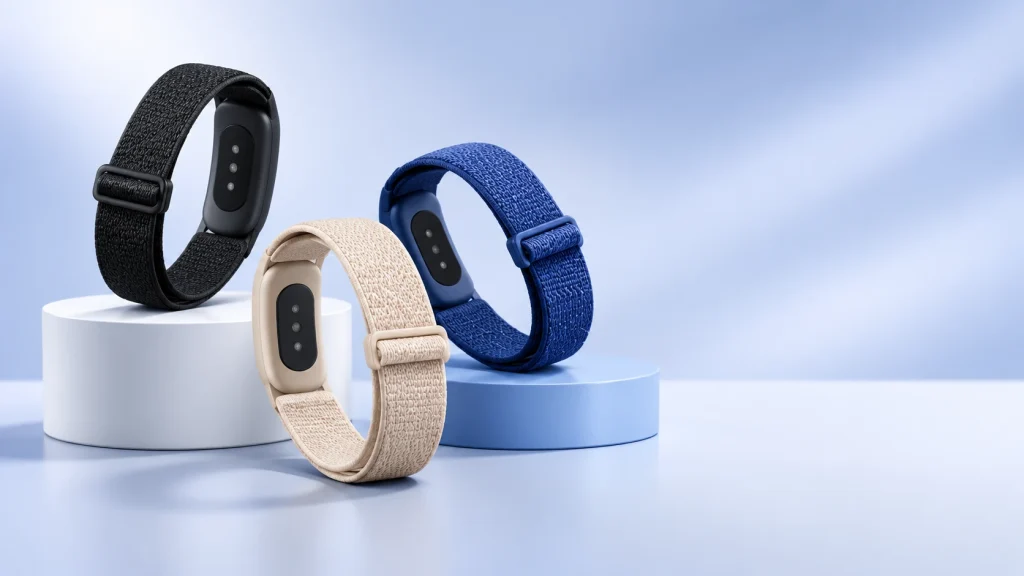
A screenless fitness tracker records your steps, heart rate, sleep and workouts without a display on your wrist. You check everything in a phone app, so there is nothing to glance at, no notifications and less screen fatigue. The category used to mean Whoop and its yearly membership. In 2026 there are real subscription-free options from Google, Garmin, Polar and Amazfit.
Quick verdict: the Google Fitbit Air is the best screen-free tracker for most people at $99.99. The Amazfit Helio Strap is the best value for battery life and a no-subscription setup. The Polar Loop and Garmin Cirqa suit people who want deeper training data, and Whoop 5.0 remains the pick for recovery coaching if you accept paying every year.
Quick picks
| Tracker | Best for | Price | Subscription | Battery |
|---|---|---|---|---|
| Google Fitbit Air | Best overall | $99.99 | Optional (Google Health Premium, $9.99/month or $99/year) | Up to 7 days |
| Amazfit Helio Strap | Best value | $99.99 | None | Up to 10 days |
| Polar Loop | Training and recovery data | $199.99 | None | Up to 8 days |
| Garmin Cirqa | Garmin users | $199.99 | None for core features | Up to 10 days |
| Whoop 5.0 | Recovery coaching | From $199/year (hardware included) | Required | 14+ days |
The best screenless fitness trackers, reviewed
1. Google Fitbit Air: best overall
The Fitbit Air costs $99.99 and tracks heart rate, sleep, daily movement and workouts. Tom’s Guide calls it subscription-free for core features, with about a week of battery. It weighs only about 5 grams without a band, works with both iPhone and Android, and charges quickly over USB-C.
Watch out for: there is no built-in GPS, and the AI Health Coach needs Google Health Premium after the three-month trial. Heart rate accuracy can slip at high intensity.
2. Amazfit Helio Strap: best value
At $99.99 the Helio Strap is a subscription-free alternative to Whoop with up to 10 days of battery and 5ATM water resistance. It can be worn on the wrist or, with the optional strap, on the upper arm, and it can broadcast heart rate to gym machines and watches.
Watch out for: the analysis is less detailed than Whoop’s, and it is thicker than most screenless bands.
3. Polar Loop: best for training data
The Polar Loop costs $199.99 with no subscription and lasts up to 8 days per charge. Polar’s sports-science background shows in its training and recovery analytics, which go deeper than Amazfit’s. It is rated for 30 metres of water resistance.
Watch out for: it costs twice as much as the Fitbit Air and Helio Strap.
4. Garmin Cirqa: best for Garmin users
Garmin’s first screenless band launched in July 2026 at $199.99. It lasts up to 10 days, uses a fabric band that can be worn on the wrist or upper arm, and needs no subscription for core tracking. Some extra software features sit behind the optional Garmin Connect+ plan.
Watch out for: its strongest case is for people already in the Garmin ecosystem.
5. Whoop 5.0: best for recovery coaching
Whoop has no hardware price. The band comes with a membership: One at $199/year, Peak at $239/year and Life at $359/year (the Life tier includes the medical-grade Whoop MG). Battery lasts 14+ days, and its sleep, strain and recovery coaching is the most polished in the category.
Watch out for: stop paying and you lose the service, so it costs far more over several years than the one-time options.
Fitness trackers without a subscription
For most people the real cost of a screenless tracker is what you pay over three years, not the sticker price.
| Tracker | Upfront | Ongoing cost | Roughly after 3 years |
|---|---|---|---|
| Amazfit Helio Strap | $99.99 | None | $99.99 |
| Polar Loop | $199.99 | None | $199.99 |
| Garmin Cirqa | $199.99 | None for core features (Garmin Connect+ optional) | $199.99 |
| Google Fitbit Air | $99.99 | Optional Premium at $99/year | $99.99 without Premium, about $400 with it |
| Whoop One | Included | $199/year | $597 |
Four of the five trackers work fully without a monthly fee. If you want one that never asks for money later, pick the Amazfit Helio Strap, Polar Loop or Garmin Cirqa. The Fitbit Air is also usable for free, but its AI coaching sits behind Google Health Premium after a three-month trial.
Screenless tracker or smartwatch? How to choose
A screenless band is better if you want 24/7 data with less distraction, comfortable sleep tracking and no notifications. A smartwatch is better if you need built-in GPS, on-wrist stats during a run, music or contactless payments.
- Decide how much you want to check. If you like glancing at your pace mid-run, a screenless band will frustrate you. If screen time is the problem, it is the point.
- Pick a payment model. One-time price (Helio Strap, Polar Loop, Cirqa) or ongoing membership (Whoop).
- Check GPS. Most of these bands do not have their own GPS and use your phone’s, so serious runners may prefer to pair them with a running watch.
- Consider your ecosystem. Garmin users get the most from the Cirqa, and Google Health users from the Fitbit Air.
- Think about battery. Ten days (Helio Strap, Cirqa) beats seven (Fitbit Air) if you hate charging.
- Wear it every night. These devices only help if you wear them continuously, so comfort matters more than a small feature advantage.
FAQ
What is the best screenless fitness tracker? The Google Fitbit Air for most people, because it costs $99.99 and works without a subscription. The Whoop 5.0 is the strongest for recovery coaching if you accept a yearly fee.
Is there a screen-free fitness tracker without a subscription? Yes. The Amazfit Helio Strap, Polar Loop and Garmin Cirqa need no subscription for core tracking, and the Fitbit Air works without one too.
Do screenless trackers have GPS? Most do not. The Fitbit Air and Helio Strap rely on your phone for location.
How long does the battery last? About 7 days on the Fitbit Air, 8 on the Polar Loop and up to 10 on the Helio Strap and Garmin Cirqa. Whoop 5.0 lasts 14 days or more.
Do they work with iPhone and Android? The Fitbit Air does, and the Polar Loop works with iPhone and Android through the Polar Flow app. Check each app’s requirements before you buy.
Sources
- Tom’s Guide: Fitbit Air review
- Wareable: Amazfit Helio Strap review
- TechRadar: Amazfit Helio Strap review
- Android Central: Polar Loop
- Tom’s Guide: Garmin Cirqa launch
- Hiconsumption: Garmin Cirqa
- Tom’s Guide: Whoop 5.0 membership pricing
Checked 7 November 2026. Prices and plans change often, so confirm on the maker’s page before you buy.
About the Author

Aman Ullah Hridoy
Founder & Content Creator
I’m Aman Ullah Hridoy, the founder of Technolozia. I write about technology, software, gadgets and practical how-to guides to help readers understand tech and make smarter digital choices.