Edge computing means processing data close to where it is created, such as on a device, a gateway or a nearby server, instead of sending everything to a distant data center or cloud. It cuts delay, saves network bandwidth, and keeps systems running when the connection drops. It works alongside the cloud rather than replacing it.
What is edge computing?
eWeek describes it as computing done at the edge of the network rather than on a centralized server. F5 adds that edge servers near users or IoT devices handle data first, then send only the essential results to the cloud. The two defining traits are proximity to the data and distributed processing.
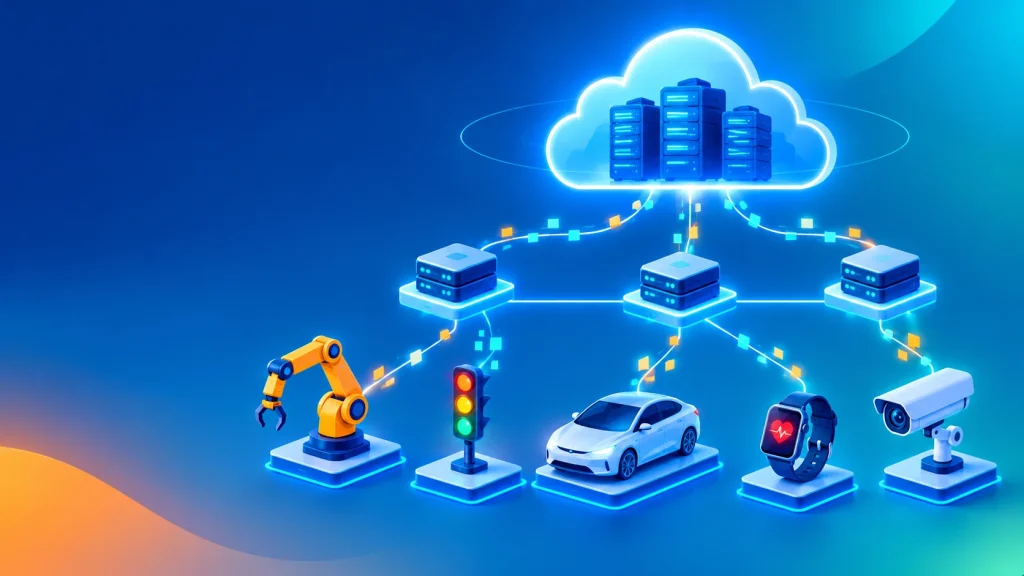
You already use edge computing. eWeek lists smartphones, smartwatches, connected cars, smart traffic lights, point-of-sale devices, robots and industrial IoT gateways as edge devices. “Edge” is a place in the network, not one product, and definitions vary slightly by vendor. TD SYNNEX shows how Gartner, TechTarget and IBM each phrase it, but all stress being close to where data is produced or used.
How edge computing works
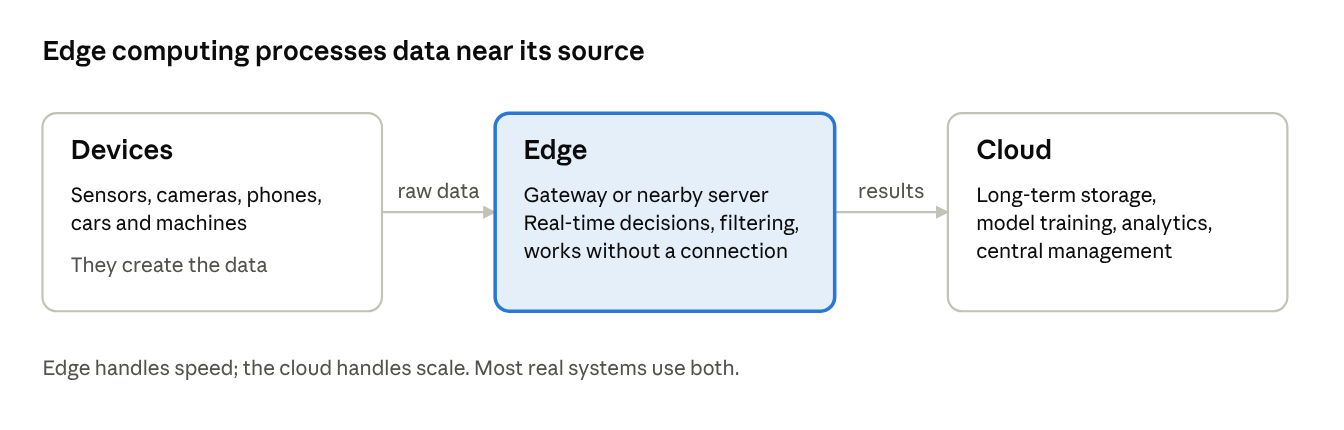
Data starts on devices. A nearby edge node analyzes it first, acting right away when speed matters and passing only useful results on. The cloud keeps the long-term record and does heavy work. Azion recommends edge for real-time inference, filtering, caching and offline operation, and cloud for long-term storage, training, analytics and central management. There is no single edge architecture, as eWeek notes, because edge devices vary so much.
Edge computing vs cloud computing
Edge wins on speed and local control. Cloud wins on scale and simple management. The table follows Azion’s comparison, a vendor page whose latency ranges are typical values with no stated measurement method, so read them as rough guides.
| Factor | Edge | Cloud |
|---|---|---|
| Where processing happens | Near the data source | Central data centers |
| Latency (typical, per Azion) | About 1-10 ms | About 50-200 ms |
| Bandwidth | Local filtering limits data sent out | All data is sent to the cloud |
| Scale | Limited by local hardware | Elastic, very large |
| Without a connection | Keeps running | Needs a network |
| Cost model | Upfront hardware plus running costs | Pay-per-use |
| Management | Distributed, more complex | Centralized, simpler |
| Best fit | Real-time, local processing | Batch work, heavy compute, storage |
Most teams use both. Use edge for the work that cannot wait or must stay local, and cloud for everything else.
Benefits and advantages of edge computing
- Lower latency. Processing near the source shortens the trip data has to make, which supports real-time decisions (TD SYNNEX).
- Less bandwidth and lower cost. Sending only essential data cuts transfer use and fees (F5). TD SYNNEX gives the example of saving only the important security footage.
- Better reliability. eWeek notes that spreading work across many devices reduces the impact of one failure. Edge systems can also keep working when the link to the cloud is down.
- Security and privacy. Less data crosses external networks, which lowers leak risk (F5). Data is not concentrated in one target, and DDoS attacks are harder to carry out (eWeek).
- Compliance. It helps meet rules that require data to be stored and processed locally (eWeek).
- New products. Many mobile and “smart” products depend on it (eWeek).
Edge computing applications and examples
Edge fits wherever data is produced in large amounts, a decision cannot wait, or the network is unreliable. These examples come from TD SYNNEX, F5 and eWeek.
| Area | Example | Why edge helps |
|---|---|---|
| Manufacturing and IoT | Factory sensors and measurement devices (F5) | Huge data volumes are hard to gather in one cloud; edge cuts delay and improves security |
| Vehicles and traffic | Autonomous cars and traffic control (TD SYNNEX) | Collision-avoidance decisions need ultra-low latency |
| Energy and buildings | Sensors in warehouses and offices (TD SYNNEX) | Real-time adjustment of machinery or lighting by peak hours |
| Smart agriculture and grids | Local monitoring and processing (eWeek) | Tracks more data close to the equipment |
| Retail and restaurants | Smart retail systems (F5); tablet kiosks that send orders to an on-site server first (eWeek) | Fast decisions at the point of sale |
| Healthcare | Computerized medical devices (eWeek) | Listed by eWeek as a type of edge device |
| Gaming | Edge connectivity close to players (TD SYNNEX) | Low latency for competitive play |
| Smart homes | Smart speakers (TD SYNNEX) | Local storage speeds up responses and reduces security risk |
| 5G networks | Telecom edge processing (F5) | Eases the latency limits of a centralized cloud |
Edge AI is another common use. F5 describes running AI and machine learning models directly on devices such as autonomous vehicles, smart retail systems, smartphones and wearables, so decisions happen at the point of interaction.
Challenges and limits
Edge adds complexity. eWeek and F5 list these main trade-offs:
- Higher cost and upkeep. Many distributed servers and devices raise deployment, maintenance and management costs, and mean more staff travel (F5, eWeek).
- Security risk at every device. A compromised device can expose the network, so each one needs protection (eWeek).
- Missing data. Sending only processed subsets to the cloud can leave out information you later need (eWeek).
- Harder scaling. Growing usually means new hardware, which is harder than adding cloud resources (eWeek).
- Physical conditions. Outdoor devices face weather, dust and damage, and power and space can be tight (eWeek).
- Few standards. Limited standardization hurts interoperability and risks obsolescence (eWeek).
- Skills. Running more edge infrastructure needs skilled staff, though central management tools can reduce the load (F5).
When edge makes sense
Azion suggests edge when:
- User-facing apps need responses in under about 50 ms.
- You produce high-volume data, such as video or IoT readings, that is cheaper to filter locally.
- Connectivity is limited or intermittent.
- Data must stay in a specific geographic area.
- Decisions are real-time, such as safety or control systems.
If none of these apply, the cloud is usually simpler. The same page warns against using edge for everything and advises keeping it for latency-sensitive, bandwidth-heavy or compliance-driven work. It also notes that edge has higher upfront costs but can lower operating costs for bandwidth-heavy workloads. Start with one use case, measure the delay and data volume you actually have, and keep the cloud for storage, training and analytics.
FAQ
What is edge computing in simple words?
It means processing data near where it is created, such as on a device or a nearby server, instead of sending it all to a faraway cloud (F5).
What are examples of edge computing?
Smartphones, smartwatches, connected cars, smart traffic lights, point-of-sale devices, robots and factory IoT gateways, per eWeek.
What are the advantages of edge computing?
Lower latency, less bandwidth use, better reliability when the network fails, and less data exposed in transit. See the benefits section above.
What are the applications of edge computing?
Manufacturing, vehicles and traffic, energy, agriculture, retail, healthcare devices, gaming, smart homes and 5G networks.
Will edge computing replace the cloud?
No. Sources describe it as complementing the cloud: edge for real-time work, cloud for storage, training and central management.
What is the main downside?
Cost and complexity. Many distributed devices need more upkeep and security than one central cloud setup.
Sources
- eWeek: What Is Edge Computing? Your Complete Guide (23 November 2021)
- F5: What is Edge Computing? (vendor glossary)
- TD SYNNEX: What is Edge Computing? (published 2 September 2021, updated 24 March 2026)
- Azion: Edge Computing vs Cloud Computing (vendor page; latency figures are typical values, not measurements)
IBM, AWS and Wikipedia pages could not be opened here, so this article relies on the pages above. Some are older or from vendors, so check current product details before buying.
Checked 8 November 2026.
About the Author

Aman Ullah Hridoy
Founder & Content Creator
I’m Aman Ullah Hridoy, the founder of Technolozia. I write about technology, software, gadgets and practical how-to guides to help readers understand tech and make smarter digital choices.