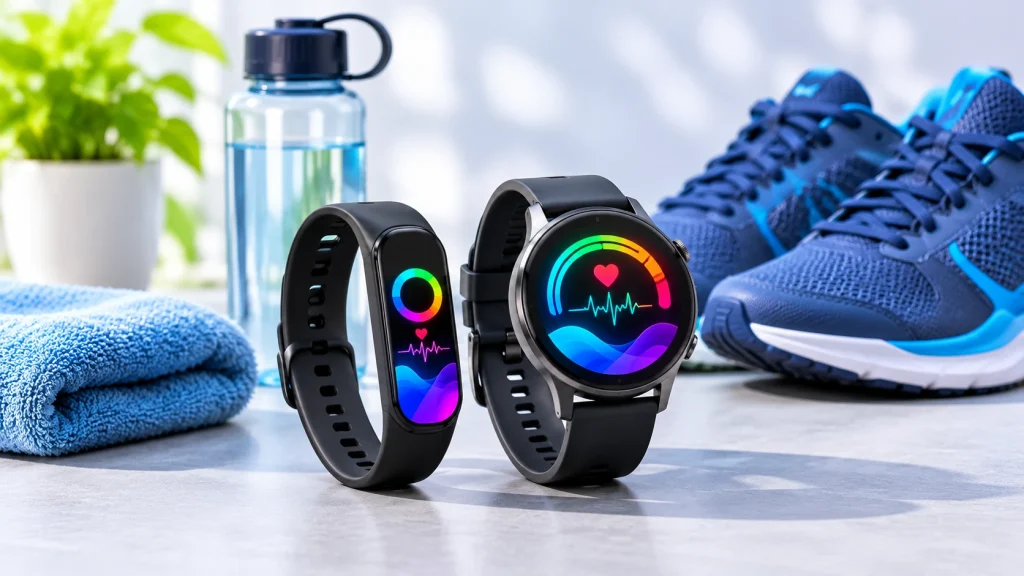
Buy a fitness tracker if you want the cheapest, lightest way to track steps, workouts and sleep, with a battery that lasts a week or more. Buy a smartwatch if you want apps, calls, payments and richer health sensors on your wrist, and you are happy to charge it every day or two.
The gap between the two has narrowed. Some trackers now have built-in GPS and bright colour screens, and some smartwatches stretch to several days on a charge. So the decision comes down to three things: how much you want to spend, how often you will accept charging, and whether you need a wrist computer or just a health tracker.
This guide compares them side by side, then shows example products from recent reviews. Prices and battery figures come from those reviews, so check a live listing before you buy.
Fitness tracker vs smartwatch at a glance
| Fitness tracker | Smartwatch | |
|---|---|---|
| Typical price | Under about $150; budget bands cost far less | About $250 to $400 for mainstream models; $700 or more for rugged ones |
| Battery life | About 7 to 21 days | About 1 to 2 days for most; a few last 3 to 5 days |
| Screen and design | Slim band, small display | Larger watch-style display, always-on option |
| Apps and smart features | Notifications, basic controls | Downloadable apps, music, payments, calls with LTE |
| Health tracking | Heart rate, steps, sleep, workouts; some have GPS | The same, plus ECG, blood oxygen and extra sensors on many models |
| Best for | Sleep tracking, beginners, tight budgets | Notifications, training tools, safety features, phone independence |
The figures above are ranges drawn from the example products later in this guide. They are not rules, and individual models vary.
What a fitness tracker does
A fitness tracker is a slim band focused on health basics: steps, heart rate, workouts and sleep. It is built to be worn all day and all night, so comfort and battery life matter more than apps. TechRadar recommends a tracker for people who want sleep tracking, because it can be worn for days without charging, and for beginners, because the price is much lower than a smartwatch.
Examples from Engadget’s roundup show the range:
- Fitbit Charge 6: Up to 7 days of battery, built-in GPS and a more accurate heart-rate monitor. The downsides are no Apple Health integration and some data behind the Fitbit Premium paywall.
- Garmin vivosmart 5: $150, up to 7 days of battery, slim design and strong workout tracking. It uses your phone for GPS and its app is harder to use.
- Xiaomi Smart Band 9: The budget pick, with up to 18 days of battery, a full-colour display and good sleep tracking.
Android Central lists the newer Xiaomi Smart Band 10 with a 1.72 inch AMOLED screen and a 21-day battery, but no GPS or NFC. That sums up the trade: long battery and low price in exchange for fewer smart features.
What a smartwatch does
A smartwatch is a small computer on your wrist. It runs a full platform such as watchOS or Wear OS, so you can install apps, stream music, pay and, on LTE models, take calls without your phone. Most also track workouts, heart rate and sleep, and many add ECG or blood-oxygen sensors. The price you pay is battery life and cost.
Recent reviews show how much models differ:
- Apple Watch SE 3: From $249, with 18 hours of battery (up to 32 hours in Low Power mode), per Engadget. It has no ECG or blood-oxygen sensor.
- Apple Watch Series 11: From $399, 24 hours of battery and hypertension alerts. The Ultra 3 costs $799 with 42 hours. All Apple Watches work only with an iPhone.
- Google Pixel Watch 5: From $399.99, about two days of battery in testing, per TechRepublic. It works with most phones on Android 12 or later.
- Samsung Galaxy Watch9: From $379.99, but the 44mm test unit barely lasted a full day. Some features need a Samsung phone.
- OnePlus Watch 3: $349.99, with just under three days in Wareable’s heavy-use test.
The pattern is clear: mainstream smartwatches want charging every day or two, and the long-battery models trade some polish for it. Newer versions may have launched since these reviews, so check what is current.
Battery, price, accuracy and compatibility compared
Battery. This is the clearest difference. Trackers in the reviews above last 7 to 21 days. Most smartwatches last 18 to 40 hours, with a few reaching three to five days. If you want to wear one overnight for sleep tracking, a smartwatch needs a charging routine, such as topping up while you shower. Battery claims use different test settings, so treat them as guides, as TechRepublic also warns.
Price. Trackers start far lower. The vivosmart 5 at $150 is the priciest tracker in the examples, while mainstream smartwatches begin around $250 (Apple Watch SE 3) to $400 (Pixel Watch 5, Apple Watch Series 11). Rugged models such as the Apple Watch Ultra 3 ($799) and Galaxy Watch Ultra2 ($699.99) cost more.
Accuracy. Wrist sensors estimate heart rate, steps and sleep, and results vary by model and by activity. In Android Central’s testing, reported by TechRepublic, the Pixel Watch 5 tracked reference devices more closely than the Galaxy Watch9. Fitbit’s tracker, by contrast, has a more accurate heart-rate monitor than before, per Engadget. For serious training or medical concerns, a wrist device is not a substitute for a chest strap or a doctor.
Compatibility. Check this before you buy.
- Apple Watch works only with an iPhone.
- Pixel Watch 5 works with most phones on Android 12 or later, though some features need a newer Pixel.
- Galaxy Watch9 needs Android 13 or later, and some features need a Samsung phone.
- Fitbit Charge 6 has no Apple Health integration, while the Garmin vivosmart 5 syncs with it.
Subscriptions. Some trackers keep part of their data behind a paywall, such as Fitbit Premium on the Charge 6. Check what is free before you buy.
Example picks: trackers and smartwatches
| Device | Type | Best for | Reported price | Battery | Phone support |
|---|---|---|---|---|---|
| Xiaomi Smart Band 9 | Tracker | Budget | Check live listing | Up to 18 days | Android, iOS |
| Fitbit Charge 6 | Tracker | Best overall tracker; built-in GPS | Check live listing | Up to 7 days | Android, iOS |
| Garmin vivosmart 5 | Tracker | Slim, strong workout tracking | $150 | Up to 7 days | Android, iOS |
| Apple Watch SE 3 | Smartwatch | Lowest-priced Apple Watch | From $249 | 18 hours | iPhone only |
| Google Pixel Watch 5 | Smartwatch | Most Android users | From $399.99 | About 2 days in testing | Android 12 or later |
| OnePlus Watch 3 | Smartwatch | Longest battery of the group | $349.99 | Up to 5 days claimed | Check compatibility |
| Galaxy Watch Ultra2 | Smartwatch | Rugged, outdoor use | $699.99 | About 4 days in Wareable’s test | Check compatibility |
One middle-ground idea: if you want a smartwatch but hate charging, the OnePlus Watch 3 is the longest-lasting of the mainstream watches listed. If you want a tracker but need GPS without carrying your phone, the Fitbit Charge 6 has it built in.
How to choose: tracker or smartwatch?
| If you… | Choose | Why |
|---|---|---|
| Want to track sleep every night | Fitness tracker | Lasts days, so you do not have to charge it before bed |
| Are new to fitness or on a tight budget | Fitness tracker | Much cheaper; trackers like the Xiaomi band cost far less than watches |
| Hate charging | Fitness tracker, or a long-battery watch | Trackers last 7 to 21 days; the OnePlus Watch 3 lasts several days |
| Use an iPhone and want notifications, apps and payments | Apple Watch | Best integration, but iPhone only |
| Use Android and want a full smartwatch | Pixel Watch 5 or Galaxy Watch9 | Wear OS with broad health features |
| Want to leave your phone at home | Smartwatch with LTE, or a tracker with built-in GPS | LTE watches handle calls; trackers like the Charge 6 map runs |
| Do outdoor sports or long trips | Rugged smartwatch | Ultra-class watches add battery, durability and satellite or GPS features |
| Buy for a child, teen or older parent | Fitness tracker | Simple, light and inexpensive |
Before you pay, ask yourself three questions. Will I really use apps and calls on my wrist? Will I charge it daily? Does it work with my phone? If the honest answer to the first two is no, a fitness tracker is the better value. If you answer yes to all three, a smartwatch is worth the premium.
FAQ
What is the difference between a fitness tracker and a smartwatch? A fitness tracker is a slim device focused on steps, heart rate, workouts and sleep, with a battery that lasts days. A smartwatch runs a full platform with apps, payments and, on some models, calls, but usually needs charging every day or two.
Which is better for sleep tracking? A fitness tracker, in most cases. It can be worn for days without charging, so it is practical overnight, as TechRadar notes. A smartwatch can track sleep too, but you need to charge it at another time.
Which has better battery life? Fitness trackers. The Xiaomi Smart Band 9 lasts up to 18 days and the Fitbit Charge 6 up to 7 days. Apple Watch SE 3 lasts about 18 hours.
Are fitness trackers cheaper than smartwatches? Yes. Trackers cost less than about $150 in the examples above, while mainstream smartwatches start around $250 to $400.
Do I need a smartwatch if I have a smartphone? Not necessarily. A smartwatch adds convenience, such as glancing at notifications or paying from your wrist, but your phone already does the same things.
Can I use an Apple Watch with Android? No. Apple Watches work only with an iPhone. Android users should look at Wear OS watches such as the Pixel Watch 5 or Galaxy Watch9.
Are fitness trackers accurate? They give reasonable estimates for steps, heart rate and sleep, but accuracy varies by model and activity. They are not medical devices.
Should I wait for newer models? New watches launch every autumn, and older ones often drop in price. Check what is current before buying.
Sources
- Fitness tracker vs smartwatch: which is best for you? TechRadar
- The best fitness trackers for 2026, Engadget
- Best fitness trackers, Android Central
- 4 best Wear OS smartwatches for 2026, TechRepublic
- The best Apple Watch in 2026, Engadget
Prices and specs change often. Checked 8 November 2026.
About the Author

Aman Ullah Hridoy
Founder & Content Creator
I’m Aman Ullah Hridoy, the founder of Technolozia. I write about technology, software, gadgets and practical how-to guides to help readers understand tech and make smarter digital choices.